lørdag 26. februar 2011

Twitter and more multi-tasking coming to Windows Phone in 2011


Microsoft’s Steve Ballmer spoke this morning at Mobile World Congress in Spain and announced several upcoming improvements for the Windows Phone platform. He also confirmed that the first free update will be coming in the first two weeks of March that includes copy & paste and faster application performance.

Other news regarding updates and new features includes:

  • Availability on CDMA Networks - With added support for CDMA networks, Windows Phone will be available to even more customers on mobile operators such as Verizon and Sprint in the first half of 2011.
  • Twitter in the People Hub - The popular social networking service Twitter will be integrated into the People Hub in the second half of 2011.
  • Office Document Storage in the Cloud - Document sharing and storage in the cloud via Windows Live SkyDrive will be added to Windows Phone in the second half of 2011.
  • Next Generation Browsing with Internet Explorer Mobile - A dramatically enhanced Internet Explorer Mobile web browser will be added to Windows Phone in the second half of 2011. It will feature the same standards support (HTML5, etc.) and hardware accelerated graphics as the PC version.
  • Additional Multi-tasking Capabilities - We will add the ability to switch quickly between applications, run applications in the background (such as listening to music), along with a number of other capabilities in the second half of 2011. Developers will learn much more about this during April’s MIX conference.

The Twitter integration is not that important to me as there are some great 3rd party Twitter apps, but it is still good to see them acknowledge Twitter as an important social network to include. I like the Office document storage feature and hope that the additional multi-tasking works with the BringCast podcast app. Even better would be to see the Zune software improved with better podcast support.

I am also hoping that this first update includes some manufacturer specific fixes, such as improved camera software on both the HTC HD7 and Dell Venue Pro.

fredag 25. februar 2011

Indian cabinet approves caste-based census for 2011

Indian census official chats to a resident in Delhi on 11 May 2010

Officials are spending a year classifying India's population of around 1.2 billion people

India's first caste-based census since 1931 will take place next year, the cabinet has announced.

It said the controversial count would last from June-September 2011, after a full census had been held. Answering questions on caste will be optional.

The move is intended to help target affirmative action benefits.

Discrimination relating to caste in Hinduism - the complex social hierarchy originally based on people's occupations - is banned in India but still goes on.

Critics of the caste survey say it is open to fraud.

Campaigners say the caste system is a highly regressive feature of Indian society and that it reinforces hierarchy and breeds inequity.

Separate survey

The cabinet's decision is the final ratification needed after a group of ministers gave the go-ahead for the caste census last month.

"A separate house-to-house enumeration of caste will be done during the period June 2011 to September 2011," Home Minister P Chidambaram told reporters in Delhi.

"This satisfies all the various requirements that have been projected and discussed and debated extensively."

Mr Chidambaram did not say how much the separate caste survey would cost. The Press Trust of India put the price tag at $650-$850m.

The BBC's Sanjoy Majumder in Delhi says that the move is aimed at improving affirmative action among the country's most socially disadvantaged groups.

Our correspondent says that independent India has always tried to present a unified face for its diverse ethnic, religious and social groups and outlaws discrimination on the basis of caste.

But the caste system still pervades many facets of Indian life, especially marriage.

The only time caste has been included in India's census was in 1931 when the country was ruled by Britain.

India's main population census was launched in April.

Some 2.5 million census officials will spend a year classifying India's population of around 1.2 billion people according to gender, religion, occupation and education.

It will include photographs and fingerprints of everyone aged over 15 to create a biometric national database to enable the government to issue national identity cards.

Full results are due in mid-2011.


Former bandit spearheads Indian state's anti-Maoist war

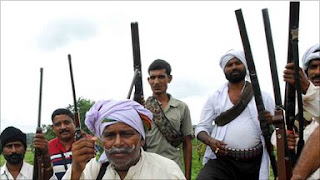
Ram Bachchan Yadav and his militia

Mr Yadav has formed his own militia to fight the Maoists (Photos: Prashant Ravi)
Continue reading the main story

Related Stories

Maoist rebels in the Indian state of Bihar are up against a formidable enemy which does not come in the shape of the army or the security forces.

A former "most wanted" bandit is now at the forefront of the campaign against them.

And it seems that the rebels - who say they are fighting an armed insurrection on behalf of rural landless labourers and the poor in more than a third of India's 600-odd districts - are not sure how to respond to him.

The Maoist insurgency has been described by Prime Minister Manmohan Singh as the country's biggest internal security threat.

Lawlessness

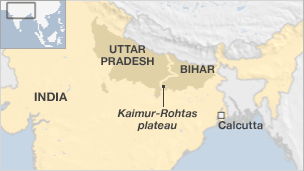
In the Maoist-controlled hills of the Kaimur-Rohtas plateau in the south-west part of the state Ram Bachchan Yadav - alias Pehalwanji - is a name which spells terror among the guerrillas.

Map

Sexagenarian Mr Yadav lives and moves around in the hilly forest tracts where even the most elite forces of Indian police dare not to visit.

Last month Mr Yadav and his men had an 18-hour long firefight with the Maoists at Rehal village.

Mr Yadav and his militia of 30-35 members not only forced the Maoists to flee from the area but also captured four of them, including a zonal commander.

Later, they trekked 18.6 miles (30km) to reach the nearest police station and hand over the captured Maoists and their cache of arms and ammunition.

So far, Mr Yadav and his men say that they have foiled more than six major Maoist attacks in the Kaimur-Rohtas hills, which were once infamous for lawlessness.

The father of four - he has two young sons and two married daughters - says his declared purpose in life is to remove Maoists from the Kaimur-Rohtas hills for good.

'Maoist hit-list'

"I appeal to all to arise and awake against the Maoist menace... and participate in country's freedom struggle.

Continue reading the main story

Start Quote

Ram Bachchan Yadav

I'll keep fighting them [the Maoists] till my last breath”

End Quote
Ram Bachchan Yadav


"We've to fight for our freedom again from the red rebels," Mr Yadav told the BBC.

He says that the militia he has formed - the Kaimur Shanti Sena (KSS, or Kaimur Peace Keeping Force) - was established to achieve this.

"With about 20 rifles, 15 double-barrel guns and these young volunteers, I fight the Maoists and have been successfully chasing them away," he says.

"I believe in myself and the cause I'm fighting for."

Kaimur district police chief Pradeep Kumar Shrivastva says that Mr Yadav and his team have reduced "insurgency incidents" in the Kaimur hills.

"He is on top of the Maoist hit-list," says Mr Shrivastva, who says that Mr Yadav is not doing anything illegal.

"If the KSS operates solely to defend themselves, the law doesn't come in their way."

There are about 168 villages on the hilly terrain of the Kaimur-Rohtas plateau and the bordering area of the state of Uttar Pradesh. Up until now it has been a safe hideout for the Maoists.

The police say that the rebels have heavily mined the area so that they are unable to combat them without full preparations.

"They have often blown up police vehicles, schools and government buildings in the area," Mr Shrivastva said.

But Mr Yadav has not always been fighting the Maoists.

Continue reading the main story

INDIA'S MAOIST INSURGENCY


Maoist rebels in Chhattisgarh


  • Violent rebellion began in 1967 in West Bengal village of Naxalbari and spread over rural areas of central and eastern India
  • Led by elusive military commander Kishenji, supported by between 10,000 and 20,000 fighters
  • More than 6,000 killed since rebellion began
  • Worst attacks include 76 killed in April 2010 ambushes in Dantewada; 55 killed in attack on police outpost in 2007

He was released from six years in jail in 1993 and was living a "peaceful life" until the Maoists banned the collection of wood in forests and the grazing of cows for milking purposes.

He said that this move created "serious livelihood problems" for milkmen of the Yadav caste of Bihar. Yadavs are traditionally farmers who graze cattle.

Mr Yadav strongly opposed this Maoist diktat and also their abduction in July of 17 Yadav caste villagers.

They were released only after their guns and other weapons were confiscated.

Soon afterwards he formed the KSS.

"I'll keep fighting them till my last breath," he says.

"Give me more licensed weapons and I'll make Kaimur-Rohtas hills free from the Maoists in a month."

Brigand

To hear the story of Mr Yadav's "personal turnaround" first hand - as I did while travelling through the dense forestry that surrounds his village - it's tempting to compare it with any Bollywood movie of the late 1960s and 70s.

Mr Yadav talking to villagers in south-western Bihar

Mr Yadav has built up a rapport with the local community

Accused in 104 cases with a huge reward on his head from the central government, Mr Yadav was literally a brigand throughout the 1980s.

At that time he was the most wanted man not only in the Kaimur-Rohtas area but also in Uttar Pradesh.

He argues that he took up arms to counter other bandits of the area.

Whatever the truth, the bloody war between them claimed the lives of dozens of people.

With all his rivals eliminated, Mr Yadav surrendered in September 1987 and was only released from jail in January 1993.

He says that he has now been acquitted in 101 of the 104 cases against him - and the remainder are "false".

But the strong likelihood is that no-one dares to give evidence against him in a court of law.

"I'm forced to take up guns to fight against the Maoists and those who are with Maoists are my enemy," he says.

It seems as if the authorities could do with all the help they can get.

The state police record says that out of a total of 38 districts in Bihar, 31 are Maoist-affected - and 20 of them, including the Kaimur-Rohtas area, come under the "most sensitive" category.

In the last five years, Bihar has had 56 Maoists attacks in which 125 policemen were killed.

Only last month the rebels killed seven policemen, injured 10 and abducted four of them in an incident which saw the state government effectively held to ransom for a week.


India toilet cleaners stage protest over conditions

Collecting waste in Nand Nagri, on the outskirts of Delhi, India

Manual scavenging is supposed to have been banned

Hundreds of Indian workers employed to manually clean non-flush toilets have protested in Delhi against their working conditions.

They say that the authorities have failed to act despite declaring such work illegal, and should issue an apology for decades of discrimination.

Government figures suggest that about 300,000 low-caste Dalits are still employed in such work.

They are estimated on average to earn less than $4 (£2.50) a month.

The demonstrators began their protests a month ago by criss-crossing the country to highlight their demands.

Manual "scavenging" - removing human excreta from dry or non-flush toilets - is a centuries-old practice in India.

It is mainly carried out by the Dalits, formerly known as the untouchables, who are at the lowest rung of the Hindu caste system.

They go from house to house every morning to collect night soil, a euphemism for human faeces.

Although manual scavenging is prohibited by law, some government departments still have such workers. These include the railways ministry, which employs people to clean railway tracks as most trains have open-discharge toilets.

Government figures show there are more than 300,000 manual scavengers in India, but unofficial estimates put the number at more than one million.

The organisers of the protest say they want the government to completely eradicate the practice and rehabilitate those engaged in it.

They say that there will be a countrywide protest from November if the government fails to meet their demands.


Corporal punishment 'widespread' in Indian schools

Schoolchildren

Punishments included hitting pupils with sticks and tying them to chairs

Corporal punishment is still widespread in India's schools, despite the fact it is illegal, according to a report.

More than 65% of children on average said they had received corporal punishment, according to children's organisation Plan International.

Its report found that the majority of these children attended state schools.

Out of the 13 countries which were the subjects of the research, India was ranked third in terms of the estimated economic cost of corporal punishment.

Stick beatings

The study, Prevention Pays, found discrimination by caste and gender was the major cause of violence against children in India.

Plan said many children abandoned school because of the punishments, which included hitting pupils with hands or sticks, making them stand in various positions for long periods and tying them to chairs.

Continue reading the main story


Corporal punishment in India


Reports by children

State

Yes (%)

No (%)

Source: Plan/Ministry of Children and Child Development


Andhra Pradesh


50.03


46.97


Assam


99.56


0.44


Bihar


47.45


52.55


Delhi


69.11


30.89


Goa


34.25


65.75


Gujarat


48.97


51.03


Kerala


57.58


42.42


Madhya Pradesh


48.73


51.27


Maharashtra


75.9


24.1


Mizoram


90.86


9.14


Rajasthan


17.87


82.13


Uttar Pradesh


81.59


18.41


West Bengal


55.56


44.44


Total


65.01


34.99


Plan's report is taken from research carried out by the Overseas Development Institute (ODI), a UK think tank.

The ODI based its research on several sources, including Indian government data about child abuse in the country.

Delhi's Ministry of Women and Child Development interviewed more than 3,000 school children in 2007 to find out the extent of corporal punishment.

In total, nearly 12,500 children aged between five and 18 years old, including many who did not attend school, from 13 states took part in the research; more than half of them said they had faced sexual abuse.

The study found that more boy students (54%) suffered corporal punishment than girls (45%).

Students in the states of Assam, Mizoram and Uttar Pradesh reported the highest rates of corporal punishment, while Rajasthan and Goa had the lowest.

Plan said the main causes of violence against young Indians, including in schools, was discrimination on the basis of caste and gender; "societal acceptance of violence as a form of discipline"; and a general lack of awareness about children's rights.

The study found there were on average at least five beatings of students per day in the schools included in the survey.

Teachers tended to justify their actions by saying they were overburdened with too many pupils.

The study found that even many students believed corporal punishment was sometimes necessary.

Plan reckons anything between $1.4bn and $7.4bn was being lost every year in India in social benefits because of school violence.

The cost is based on estimates of how the larger economy is affected by the impact of corporal punishment on pupils' attendance and academic performance.

Only the US and Brazil suffered a greater economic cost because of corporal punishment, according to the research.

Plan said it had introduced a campaign to raise awareness about the impact of violence on children, Learn Without Fear, in seven Indian states.

The other 10 countries involved in Plan's study were Bolivia, Colombia, Ecuador, Peru, Nicaragua, El Salvador, Guatemala, the Dominican Republic, Jordan and Egypt.


Caste discrimination in the UK could be outlawed

Theresa May

Theresa May is expected to make a decision on legislation in the new year

Discrimination on the grounds of caste exists in the UK, research suggests.

The study, by the National Institute of Economic and Social Research, found evidence of harassment in the workplace, in the provision of services and in education.

The government will now consider the evidence to determine whether there is a serious enough problem to impose a legal ban on caste discrimination.

The prejudice affects members of the mainly Hindu and Sikh communities.

A person's caste is their historic social standing and often refers to their forefathers' occupation.

Bullying

Someone who works with animal products or in domestic services is often regarded as being of a lower caste than someone who is a landowner or priest.

A person's surname identifies what caste they come from which can then lead to bullying.

Hindu campaigners have long argued that members of the lower caste - referred to as Dalits or "untouchables" - suffer unfair treatment at the hands of higher caste members, even in second generation UK Asian communities.

Continue reading the main story

Start Quote

I have a customer, who is from a higher caste than me and she refuses to make any physical contact with me”

End Quote
Reena Jaisiah


Reena Jaisiah, 30, from Coventry, said she had been the victim of harassment throughout her whole life because she was of a lower caste.

"It started when I was at school, I experienced bullying and name calling," she said.

''It really affected my self-esteem and made me feel low and inferior."

Reena runs a family newsagents in Coventry and said the harassment continues now.

''I have a customer, who is from a higher caste than me and she refuses to make any physical contact with me.

"She will never taken any change from me because she doesn't want to touch me. This is a shocking practice of caste prejudice in this country,'' she said.

Caste discrimination has not been explicitly covered by British legislation before and ministers have previously said they did not think it was a problem in the workplace.

The report, which is due to be published this week, was commissioned by the Government Equalities Office after an amendment to the Equality Act 2010.

The findings of the report now pave the way to outlaw discrimination on grounds of caste and Home Secretary Teresa May will make the final decision which is expected early next year.


torsdag 24. februar 2011

Murdered by her father for becoming a Western woman

Hina Saleem

Hina's family helped her father bury her in his back garden
Continue reading the main story

Related Stories

Hina Saleem paid the ultimate price.

A 20-year old Pakistani woman who lived in northern Italy, she was murdered by her father who claimed he was "saving the family's honour".

Mohammed Saleem said he didn't like the way Hina was living her life and told the authorities she brought shame on his family.

So he slit her throat. Twenty-eight times.

"I didn't want to kill her," he pleads, "I wanted her to come back home".

Mohammed Saleem has spoken from his prison cell, where he's serving 30 years for the murder.

The BBC has been given access to that interview which gives a rare insight into the mind of a perpetrator of "honour killing".

Treason

"I'm a good father," insists Saleem. "My daughter was good before. She was very, very good. Then, all of a sudden, she changed."

Continue reading the main story

Start Quote

We continue to underestimate the problem, because these ethnic groups live their own lives with little integration, especially for women”

End Quote
Souad Sbai
Association of Moroccan Women in Italy

For Mohammed Saleem, the thing that changed, "all of a sudden", was Hina's lifestyle. She had come to Italy as an Asian girl, but had grown into a Western woman.

She refused an arranged marriage, she smoked and she lived with an Italian boyfriend. For Hina, this was normal. For her father, this was treason.

To him, she represented a threat to his pride, dignity and standing in the Pakistani community.

To have a "wayward" daughter like Hina was, in his view of the world, an unacceptable challenge to his position.

For "wayward", read Western. Hina, he was saying, was effectively betraying her roots, traditions, culture and religion by embracing the more liberal life of a European teenager.

"I didn't want my daughter to be too free," Saleem says from prison.

This was murder, but it was a calculated, slow-burn murder.

'Double conflict'
Mohammed Saleem

Saleem said he did not want his daughter to be free

Hina's transition from the apple of her father's eye, to the victim of his murderous rage, is now the subject of a new book called Hina: This is my life.

One of the authors, Marco Ventura, says father and daughter were on a complicated collision course from the moment they arrived in Italy.

"In this story there is a double conflict," says Marco. "There is a conflict between cultures and a conflict between generations, between father and daughter."

Although the murder itself was Saleem's sole enterprise, the project was not. He garnered support from other members of the extended family to bury her in his own back garden.

He rationalises the act of burial like this: "When she died, the only thing I wanted, was to bring her back home."

The co-author of the new book, Giommaria Monti, has given this much thought.

"The parents no longer spoke the same language as their daughter," he says. "Burying her in the garden of the family home brought her back to where she belonged. Hina was their possession."

Global problem

Hina Saleem's murder, of course, is not unique.

The United Nations Population Fund believes that, globally, as many as 5,000 women and girls are killed each year by members of their own family in the name of "honour".

Hina Saleem

Hina's father felt his daughter's lifestyle had changed "all of a sudden"

Men, too, are targeted if, for example, they marry outside their caste or religion. But these cases are much rarer than those involving women.

The physical task of "restoring honour", of exacting a price, mostly falls to men.

The legal task of bringing the killers to justice falls to the authorities, but many countries have, what might be called, an accommodating attitude toward such honour-motivated killings.

In the penal codes of countries like Argentina, Ecuador and Syria, there is even a partial, or complete defence, for such killings.

In other words, some societies take an almost tolerant view towards "honour killings", regarding them as a kind of sub-species on the murder spectrum, especially if their purpose is to uphold widely supported virtues and standards.

In Italy itself, there was a legal defence to this form of murder until 1981. That has now been repealed.

Activists working to draw attention to the problem say Western societies must share the blame for their collective inaction.

Souad Sbai, an Italian member of Parliament, founded the Association of Moroccan Women in Italy, a group that speaks out about such cases.

"Cases of 'honour killings' represent a failure of the system of multiculturalism," she says. "We continue to underestimate the problem, because these ethnic groups live their own lives with little integration, especially for women."

"They have very little control in communities where men try to perpetuate the lives and customs they lived in their home country," says Souad.

Mohammed Saleem still feels Hina shamed him, but he now claims he regrets killing her. Not because he lost his daughter, but because of the effect of his murder on the rest of his family.

"It's not only Hina who died," he says "My whole family died. Without my son, without my wife, this is not a life," he says, with a hefty measure of self-pity.

The purpose of talking to a convicted murderer was not to evoke sympathy, but to try to understand.

Did her violent death restore his family's "honour"?

Well, as the family has now been split apart, it's a tainted, diluted kind of restoration, if it did.

Hina's appalling, avoidable, fate shows a very expensive price has been paid.